
A Fish Pond
The morning was still dark when I left my small shop.
The street was quiet. A soft fog sat over the road like a thin white cloth. The lamps above the footpath gave off weak yellow light. My shoes made a soft sound on the wet ground as I walked. I had not slept much. I had opened the shop late the night before, and my back still hurt. But I had to go. The fish at the market would not wait, and if I was late, I would lose money.
I pulled my jacket closer and kept walking.
My shop was small. It sold bread, rice, tea, soap, and other things people needed each day. It was not a big life, but it was mine. I worked hard for it. Every coin mattered. Every minute mattered too.
I was thinking about all the things I still had to do when I heard a sound.
At first, I thought it was a cat.
Then I heard it again.
A small cry.
I stopped near the corner and looked across the street. At the edge of a narrow footpath, under a tree, there was a little girl. She was standing very still. Her red school bag hung from one shoulder. Her face was wet with tears.
She looked lost.
I glanced at my watch. If I kept going now, I could still reach the market before the best fish were gone. If I stopped, I might miss the bus that took me there. If I missed that bus, my whole day could be ruined.
The girl rubbed her eyes with her sleeve and cried again.
I told myself to walk on.
I had been late too many times before. My boss at the market had already warned me once. And yet my feet did not move. The girl looked so small in the fog. She looked like she had stepped out of her home and then lost the whole world.
I turned back.
“Hello,” I said softly. “Are you alright?”
She looked up at me with wide eyes. “I can’t find my mum.”
Her voice shook. She tried to be brave, but she was too scared to hide it.
I crouched down a little so I would not seem so big. “What is your name?”
“Mina.”
“Alright, Mina. Do you know where you last saw your mum?”
She shook her head. “Near the bus stop. Then I went to look at the fish pond. When I came back, she was gone.”
A fish pond?
I looked around. On the other side of the road there was a small park. In the middle of it was a pond with a stone edge. A few people in our town went there early in the morning to feed the fish. I knew the place well. My own son used to like it when he was small.
But my son was not small now. He lived far away, and I had not seen him in two years.
I pushed that thought away.
“Can you show me?” I asked.
Mina nodded and wiped her nose.
We walked together through the fog. She held the strap of her school bag so tight that her fingers turned white. I kept watching the road. The market bus could come at any time. If it did, I would have to choose again.
At the pond, the water was calm and dark. A few orange fish moved near the top. They made tiny circles in the water. The place looked peaceful, but there was no sign of her mother.
Mina’s bottom lip started to tremble again.
“She was here,” she said. “I promise she was here.”
“I believe you,” I said.
I checked my phone. No signal.
Of course.
I looked around the park. A man in a cap was sweeping leaves. A woman with a basket was walking past. A boy on a bike slowed down, then rode on. No one seemed to notice us.
I asked Mina, “What was your mum wearing?”
“A blue dress. She had a brown bag. She said we would only stay a little while. I was feeding the fish. Then I looked up and she was gone.”
I felt a small knot in my chest.
“Did she tell you what to do if you got lost?” I asked.
Mina nodded. “Stay where I am. But I was scared.”
“That is alright,” I said. “You did the right thing by staying here with me now.”
She looked at me like she wanted to trust me but was not sure yet. That made me think of my own childhood. I once got lost at a fair when I was seven. I remember the noise, the bright lights, and my heart beating too fast. A woman selling fruit stayed with me until my father found me. She gave me a sweet and told me not to cry. I never forgot her face.
I had almost forgotten that kind of help can stay in a child’s mind for years.
A bus horn sounded in the distance.
I turned and looked down the road. There it was. The market bus. It was moving fast.
My heart sank.
If I did not leave now, I would miss it. I would lose the fish I planned to buy. I would lose money. And yet Mina was still there, trying not to cry.
I took a slow breath.
The bus kept coming.
I looked at Mina and made my choice.
“We are going to find your mum,” I said. “Come with me.”
The bus passed us a moment later, bright and loud in the fog. I watched it go by and felt my stomach drop. But I also felt something else. I felt calm. Strange, but true. I had chosen.
Mina and I walked to the small shop by the park gate. I knew the man who ran it. His name was Mr Lee. He sold tea, buns, and phone cards. I had bought things from him many times.
“Mr Lee,” I called as we entered. “Do you know this girl’s mother? Blue dress, brown bag.”
He looked up from the counter and frowned. “I saw a woman like that. She asked for directions to the bus stop. She said she had lost her daughter for a moment.”
Mina gasped. “Where did she go?”
Mr Lee pointed down the road. “She ran towards the clinic. She looked very worried.”
“The clinic?” I said.
“Yes. She was crying. She said her younger boy had been coughing all night and needed medicine. She was trying to get there before it opened.”
Mina’s eyes grew wide. “My brother is sick.”
Now the story changed. Her mother had not gone far. She had only been trying to help her family.
Mina bit her lip. “I should have stayed.”
“You are still a good girl,” I said gently. “Your mum will be glad you are safe.”
I asked Mr Lee if he could watch the shop for just a minute while I took Mina to the clinic. He nodded at once.
“Go,” he said. “I can wait.”
We ran.
Well, I ran as fast as my old legs would let me, and Mina hurried beside me. The fog was lifting now. The morning was waking up. A few people were out walking. Some stared, but most just passed by. I did not care. Mina needed to find her mother.
At the clinic, a line had already begun to form. People stood with tired faces and folded arms. Mina looked small again. She held my hand now. I could feel how cold it was.
“What if she is not here?” she whispered.
“She will be,” I said, though I was not sure.
We went to the door and asked the nurse at the desk if a woman in a blue dress had come in with a sick child.
The nurse looked down at her notes. “Yes. She is inside with the doctor.”
Mina let out a little sob of relief.
I told the nurse that Mina had been separated from her mother. The nurse smiled and waved us through.
We found her in a small room near the back. Her mother was sitting on a chair with a younger boy asleep
The Pond at Dawn
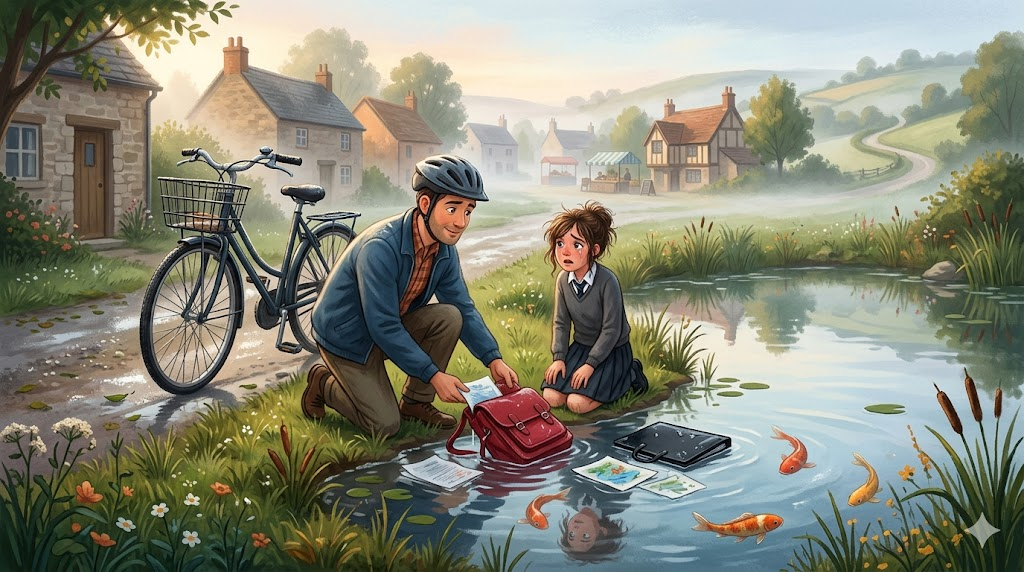
I like to ride my bike early. The streets are quiet. The air feels soft. Today there is fog. The fog sits over the small pond by the road. The pond looks like a grey mirror. Fish swim slow beneath the silver glass.
I pedal slowly. My bag is tied to the back of the bike. I have bread to drop at the shop. I am already a little late. My boss will frown. I might lose a little pay. I think about the rent and the milk. I think about my tired feet. I think about the list of small things that do not stop.
The pond is my favourite place for a moment of calm. I always slow down here. The world seems to hold its breath. The reed tips dip. A frog croaks once. The light is thin and kind.
Then I hear crying.
It is a small cry at first. Then it grows. It comes from the path by the pond. I stop my bike. The sound pulls me like a finger.
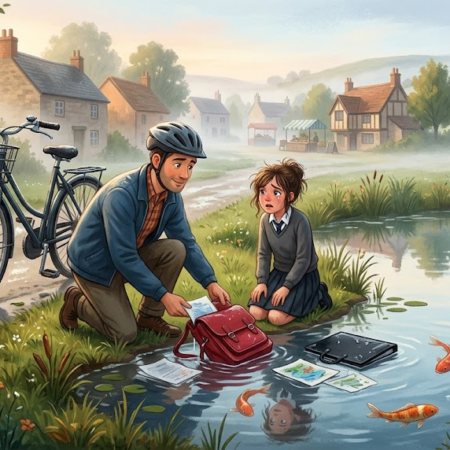
On the bank a girl sits with her legs tucked up. Her shoes are off. One shoe is wet. Water has climbed the grass and left tiny beads on her skirt. Beside her, a small black bag floats, half sunk. Papers drip out of it. The papers fall onto the water and fold. The girl grabs at them with shaking hands. She cries fast and small.
I feel my heart pull tight. I know the sting of losing things. I also know the hot rush when someone needs help. For a beat, I think of my bread. I think of my boss. I think of the money I can lose if I am late.
The girl looks up when she hears my bike stop. Her face is pinched with worry. She is young. She might be sixteen. Her hair is tied in a messy bun. Her eyes are bright and red from crying.
“Please,” she says. “My folder… my portfolio… it is ruined. It’s all wet. I—”
“Slow down,” I say. I lock my bike and come closer. The air smells of wet grass. I stand on the firm part of the path. The bank is soft and slick. One small misstep and we will both be muddy.
“What happened?” I ask.
“I stopped to feed the fish,” she says between sobs. “I put my bag on the grass. A gust of wind pushed it. It slipped. I reached—” She points. The bag lies on its side in the pond. A thin, pale sheet of paper floats free. Colours bleed in the water like the kinds of paint I used to wash off my hands when I was young.
“What’s in the bag?” I ask.
“Everything I need for my audition,” she says. “My drawings. My letters. The work I made for art school. If I miss this, I might not get in. If I don’t get in, I don’t know what to do. My mum—” Her voice stops. She presses her hand to her mouth.
She looks at me. I see fear and hope wrapped together. I think of the list in my head again. I think of rent. I think of heat and bread. I think, not for the first time, how small choices press on a person.
I could pass by. I could pedal on. I could drop the bread, wipe my brow, and try to look small and busy. That is the easy route. I think of my boss’s voice. I think of how tight money can make a day.
I think of my own small memory. When I was ten, I once sat on the curb and burst into crying because the only shoes I had split on the way to school. My neighbour, Mrs. Hale, took off her old scarf and wrapped my shoes. She walked me to class. She laughed with me later. That kindness kept me going for a long time. I still remember the warmth of that scarf.
I bend down. “Come on,” I say. “Let’s get it.”
She stands too fast. I worry she will slip. She grabs my arm and shivers. “You will be late,” she says.
“So will you,” I say. “We will be late together.”
We walk to the bank. My shoes sink into the wet grass a little. The mud smells good and clean. The bag leans on a rock. Water peels at the zipper. The strap is half over the edge. A small book floats near a water lily.
I reach slow. The mud pulls at my shoe. The strap is slippery. I get my coat sleeve damp. The girl watches with held breath. Her hand shakes on her knee.
I pull. The bag resists. A fish slips under it and shakes the water like a small laugh. For one second I think we will not get it. The bag wants to sink. I want to be quick. My fingers close on the wet strap and I tug hard. It comes free. Water runs down my arms in warm cold strips.
We pull the bag onto the bank. The girl collapses beside it and sobs out a laugh. “Thank you,” she says. Her mouth is wet with relief and tears. She hugs the bag like it is a small child.
The papers inside are soaked. Paint has smeared. The lines have run like rains on a heavy day. The top sheet is the letter from the art school. The ink is a little soft. The charcoal smudges. Her careful notes are all blurred.
“No,” she whispers. “No.”
I look at her hands. They are stained with a blue that shame makes. I look at her face. I see the same fear I have felt on mornings when the bills did not add up. I step back and try to think.
We have choices again. We can do nothing and tell her sorry. We can walk away and save our time. Or we can try to fix what we can.
“Do you have another set?” I ask.
She shakes her head. “No. I worked all night. I had to help my mum sleep. I had to clean the ward for some pay. I drew when I could. This is it. It is for a scholarship. Without it, I cannot go. My mum—she is sick and she needs medicine. If I get in, maybe I can help.”
Her words land like little stones. I remember my mother sitting at the kitchen table with her head on her hands. I remember the way the light looked through the curtains on hard days. I remember Mrs. Hale’s scarf again.
“Okay,” I say. “We will try.”
We wrap the wet papers in cloth from my bag. I tear my shirt a little and press it around them. We press with our hands. The girl, who says her name is Maya, breathes into the cloth like a small engine. We flatten the pages with rocks and books from my bike bag. The sky grows a little lighter. The fog thins. The town begins to wake.
We need a plan. The audition is in an hour. Maya says the studio is at the old hall near the river. It is not far. But time is thin. My boss will be waiting. I taste worry again.
“Do you have money for the bus?” I ask.
She shakes her head. “No. I used my last coins to buy the paper. I left the bus fare in the bag.”
I count my coins in my head. I have a little. Not much. But I remember the morning when Mrs. Hale gave me a coin for bread and told me to keep it until I needed it more. I have it in my pocket as a small promise.
“Get on my bike,” I say. “I will take you.”
She looks at me like I have said a strange thing. “But you will be late.”
“So will you,” I say. “We will be late together.”
We tuck the damp packet in the back of my bag. Maya slips on one dry shoe and leaves the other in the grass. She climbs on the carrier behind me. I tighten the strap. She holds a folded scarf to the papers like a shield.
The road is slick. The bike tires hiss on the wet. I pedal harder than I wanted. My legs burn. The pond drops behind us. The town opens up with shutters lifting. A dog barks. An old man puts out his chair. The bakery lights blink on and a warm smell tries to chase the fog away.
I think of the bread waiting now. I think of my boss’s face. I think of pay. I pedal past the bakery. My boss stands in the doorway. He sees me and raises his hand. He frowns. I wave and keep going. He does not call me back.
The old hall sits near the river. There are a few cars. People shuffle with folders under their arms. A clock on a pole ticks small and cruel. The hall door is open. A woman in a neat coat stands at a table taking names. She looks tired. Her face is kind but strict.
We slip into line. A man in the hall looks at Maya’s folded clothes and wet hair. He asks what happened. She tells him. I tell him, too. We do not hide our wet shoes. We do not ask for favours. We ask for a chance.
The woman at the table looks at the wet packet. She takes a breath. “We do not usually allow late work,” she says. Her voice is soft but holds the weight of many rules. “But we saw you come in. You look like you have a story.”
Maya’s hand trembles in mine. I let go so she can stand straight. She wipes her face with the back of her hand. I tell the woman briefly about the pond and the water and the paint that ran. I tell her about the way she stopped and cried. I speak simply. I do not make grand speeches. I say what happened.
The woman nods. She looks at the time. She walks to a small table and returns with a damp cloth. “You can try,” she says to Maya. “We will see the heart behind the work as well as the craft.”
Maya breathes out like a small bell. She is asked to sit and show her work. She spreads the damp pages on the table like fragile birds. The judges lean in. They ask her about the pieces. She talks. Her voice finds a kind pace. She says why she drew each picture. She talks about the colours that mean hope. She talks about small things—the smell of baking bread, her mother’s favourite scarf, the pond that still looked like silver in her memory even when the bag sank.
I stand by the wall and fold my wet coat around my arms. My phone buzzes quietly in my pocket. I think of the bread warm in its bag back at the bakery. I worry about my job. I wonder if I did the right thing.
On the table, the judges whisper. They look at the paper with water lines and at Maya’s face. One of the older judges taps a finger against his lip. The woman at the desk watches. She smiles a little. “We like honesty,” she says where I can hear. “We like hands that try hard.”
They ask Maya a few more questions. She answers. She tells them about wanting to help her mum. About the night she stayed up drawing. About the time she sold a small sketch to buy paracetamol. Her words are plain and true. There is no show in them. There is only the small light of a person trying.
When she finishes, the judges look at each other and nod. They tell her to wait. The hall smells of paper that dries and of strong tea.
I step outside. The air is fresher now. The fog is a memory. The pond sits in the distance like a bead of water. The town moves in neat, slow ways. My boss’s bakery sign shines. He is at the window. He watches the road. He looks a little worried.
A car pulls up. A woman I know from the market steps out. She carries a small box of tea. She sees me and waves. I wave back.
I think of my small choices again. I think of Mrs. Hale’s scarf tied over my shoes. I think of the way help can stretch like warm bread. I feel the heat in my chest that comes when you do one thing for another and it feels right.
Time ticks on. The judges call Maya. She goes in. I wait outside. A little boy ducks under the hall fence and runs off with a paper plane. A robin hops on the library wall. A cat pads across the square.
After a while, Maya comes out with a smile that is small and steady. Tears still shine, but her shoulders are straighter. She runs up to me and takes my hand. “They want me to come back next week,” she says. “They liked my story. They said I had heart.”
Her smile makes something in my chest open like a window. I laugh. My laugh is a small sound. I think of my boss now and the bread and the list. I also think of Maya’s mother and the light in Maya’s eyes. The list of small things has changed size. It is not only bills and hours. It has this new thing of a life that might change.
Maya takes a paper from the hall and folds it like a small gift. She presses it into my hand. It is a note of thanks. It smells faintly of paint and damp cloth. “Thank you,” she says. “I could not have done it without you.”
“You did it,” I say. “You did the hard part.”
We walk back toward the pond. The sun is a thin coin in the sky. The town is awake now. People nod. A boy with a skateboard offers us the path and grins. We smile back.
At the bakery, my boss is at the doorway. He is not angry. He looks relieved rather than cross. He pats my shoulder. “You had a good reason,” he says. “Take a break. Tell me about it later.”
“I will,” I say. I step in and hand over the bread. The warm smell wraps around me like home. My boss drops a small coin into my palm. It is more than I expected. He says nothing of lateness.
I sit on the step outside for a moment. Maya waves at her mother down the road. Her mother is not well, but today she looks proud because her girl might get a chance. Maya runs off with a bounce in her step. Her bag is dry enough. The papers will not be perfect, but they bear the marks of a fight to save them.
Later that day at the shop, I tell a story to Mrs. Hale. She laughs and tells me how she once helped a boy with split shoes. People listen. A child in the shop hears it and keeps the door open for an old man. A woman buys an extra loaf and hands it to a stranger who passes by with a hungry look.
I think about the morning made of small moments. I think about the way I almost kept going. I think about the soft sound of crying and the wet bag and the mud on my shoes. I think about the look on Maya’s face.
I learned something quiet on the road. I learned that small things can be big. A hand that stops can pull a life back from a small fall. A coat wrapped around papers can give hope just enough time to grow. A few minutes lost can become a future won.
Now, when I ride by the pond, I slow without thinking. I look at the people sitting by the bank. I look for small hands that might need steadying. I carry an extra scarf in my bag. I carry a little coin for bus fare. I carry a warm smile. It is a small kit. It costs very little. It gives a lot.
I tell this story to my children one night, if I have them. I tell it to anyone who will listen. I do not make it a lesson. I only say what I felt.
The pond that morning was quiet again. The fog did not come back. The fish still swam and the reeds still dipped. But the world felt softer to me. A small kindness had moved like ripples from one bank to another. It touched a girl, her mother, a busy shop, and a tired man on a bike. It touched me.
When I go to sleep now, I think of small hands holding wet paper and of warm bread waiting in a shop. I feel a little lighter. I like to think that kindness is like a small fish in the pond. It does not make a storm. It does not shout. It simply swims, and the water keeps changing around it.
I stop more. I look more. I help when I can. I do not wait for big days. I choose small ones. I keep a scarf in my bag. I keep a spare coin. I keep a warm place in my heart for the quiet, wet mornings. They are the ones that teach us who we can be.
That is how a small stop at a pond changed more than one life. It changed mine, too.

Other Articles
I run a small photo booth at the weekend fair.