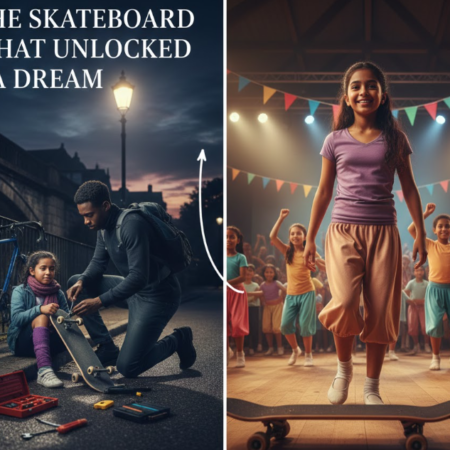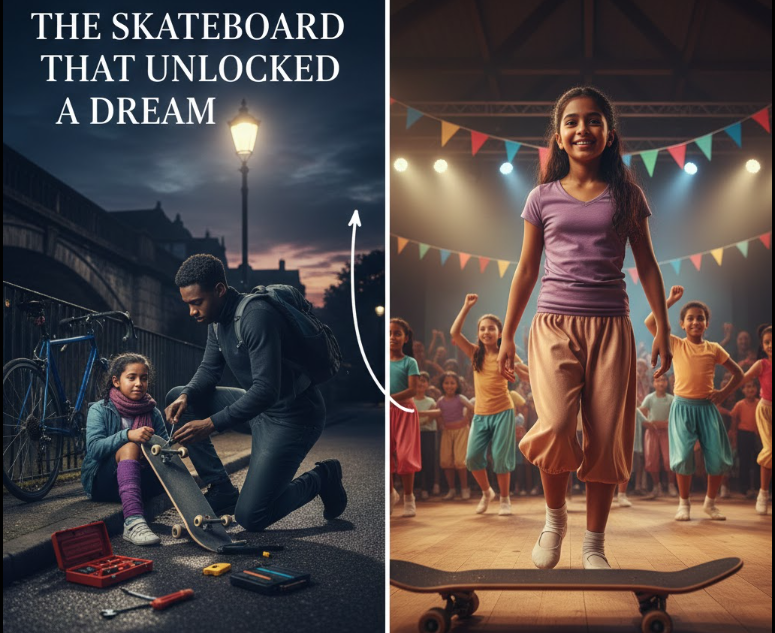

I cycle to work every morning. The road is quiet before sunrise — only birds and the hum of tires. One Tuesday, as I rode past the old bridge, I saw a girl sitting on the kerb with a broken skateboard beside her. She held her knee and breathed fast. A small crowd had gathered: kids pointing, adults watching from porches.
I stopped and swung my bike down. “Are you okay?” I asked.
She looked up. Her eyes were wide and wet. Her name was Mia. She had scraped her knee badly and her skateboard wheel was smashed. “I’m late for my audition,” she said. “If I miss it, I lose my place. I’ve waited months for this.”
I could have pedalled on. I had a meeting where I worked and could not be late. But something in Mia’s voice sounded like a small thing that might break if no one helped. I leaned my bike against the fence and knelt down.
The scrape looked deep. I wiped the dirt with water from my bottle. Mia flinched but did not cry. We wrapped her knee with my scarf to keep it clean. Her skateboard, though, was harder. The wheel was cracked and the trucks bent. The nearest shop that sold parts was across town and closed for an hour.
She lowered her head. “If I miss my turn, they choose someone else,” she said. “I’ll never get another chance.”
I thought of my own small chances — the test I had once failed, the job I had finally got after trying many times. I remembered how one second chance had changed everything. “Come with me,” I said. “I’ll fix it or we’ll get you there.”
We wheeled my bike and her broken skateboard toward the tram stop. I called a friend who ran a small repair stall in the market. “I have a girl with a broken board,” I said. “Can you help? She has an audition in thirty minutes.”
My friend Ana was there in five. She took one look and grabbed tools. “This will take ten,” she said. She bent to work with the quick hands of someone who had fixed many things. While she worked, Mia told us about the audition. It was for a youth dance group that practised on Saturdays. Mia danced because it made her fearless. Her mother worked two jobs and could not drive her. This audition was her chance to get a scholarship.
The wheel and truck were fixed, but the board felt wobbly. Ana tightened bolts and slapped a new grip tape over the top. She handed it to Mia with a small smile. “Go,” she said.
Mia stood, tried the skateboard once, then fell into a grin as wide as the sunrise. She hugged me, then sprinted to the tram. I watched her go, heart thumping like I had run the whole way.
An hour later, I got a text: “I MADE IT!!” followed by a string of dancing emojis and a photograph of Mia with the audition group, her smile bright like a lamp. My meeting was fine; I arrived late but they did not mind. I kept thinking of that quick decision to stop.
Weeks passed. I saw Mia at the market sometimes, carrying a tote bag full of flyers for her dance group’s fundraiser. She waved and told me the group was teaching kids in the neighbourhood to dance. “We want to help others have a chance like I did,” she said.
Months later, the dance group put on a small show at the community hall. Mia danced in the centre with a quiet strength. People clapped and stood. After the show, she ran to find me in the crowd and threw her arms around me. “You were my lucky person,” she whispered.
I learned something simple from that day: small choices matter. Stopping for a stranger can give them a chance to change. Fixing a skateboard took ten minutes, but it gave Mia a place to belong and a way to shine. It taught me that being on time is not always the most important thing. Sometimes being kind is.
Now, when I cycle past the old bridge, I think of Mia and the way one small act turned into many. I keep a tiny toolkit in my backpack and a spare scarf, just in case. If I see someone on the kerb with a broken thing and big hopes, I stop. Little help can make huge changes.

Other Articles
I sell newspapers by the corner of Maple and Third.
I never thought a flat tyre would change my life.