
I never thought a flat tyre would change my life.
I was on my evening run — a slow, tired jog after another long day at the supermarket. I run the same route every night: past the river, under the old railway bridge, then up Willow Hill. I like the rhythm. It clears my head. That night the sky was low and grey, like someone had pulled a blanket over the town.
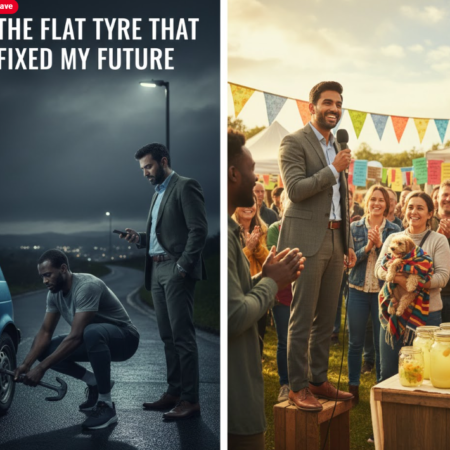
Halfway up the hill I heard a squeal that did not fit the quiet — not a dog, not a car, but a human voice with fear in it. I stopped and looked. Near the bend a man crouched beside a small blue car. His face was pale in the street light. He had his phone out but kept shaking his head.
I slowed and called out, “You okay?” My breath smoked in the cold.
He looked up quickly. “My tyre — it blew. I don’t know how to change it. My phone went dead and the spare looks old. I’m late for an interview.” His voice came out small and rushed, like someone trying not to cry.
I could have kept running. I had plans to make dinner, wash my shirt, and be early to bed. But something about his eyes stopped me. They were the kind of eyes that carried a story already halfway told. I walked over and dropped my water bottle. “I’ll help,” I said.
We pushed the car to the flat space behind a telephone box. The man introduced himself as Sameer. He was about my age — thirty-three — and shook like someone who had not slept. I took the jack and the keys and we started. The spare was indeed old; the rubber looked stiff. The wheel would not come off at first. My hands were greasy; Sameer’s were trembling.
While we worked, we talked. Sameer told me about the job — a small charity that rescued abandoned pets. He had saved every coin to travel for the interview tonight. “If I get this,” he said, “I can help more animals find homes. I can finally leave the temp job.” His voice went quiet near the end. “I promised my mum.”
The lug nuts fought us. A car passed slowly and a passer-by called, “Need a hand?” but no one stopped. The cold bit my fingers. For a moment the wheel would not budge and I thought we were stuck forever. Sameer sat back on his heels and put his head in his hands. He looked like someone who had carried worry until it made him small.
I tightened my grip and pushed harder. Sweat made my shirt stick even in the cold. The nut loosened with a noise like a sigh. The wheel came free. Sameer and I heaved the spare on. We lowered the car together. The car settled with a small thunk that echoed like a reward.
We laughed then, sharp and stunned. He clapped me on the back as if we’d won something. He tried to hand me his wallet. “You must let me pay,” he said.
I shook my head. “I’m a runner, not a mechanic. No money.”
He opened his mouth and closed it. Then he said, “You saved me. I don’t know how to thank you.”
I told him to go to the interview. “Don’t be late this time,” I joked, trying to hide how the moment made my chest feel warm. He placed his palm over his heart. “You are an angel,” he said. Then he locked the doors and drove off.
A week passed. I almost forgot the night on Willow Hill. Then on a Sunday morning I was at the weekly community market selling jars of lemonade for my friend’s stall. The market is where everyone in town meets: bakers, gardeners, people with stories in their shopping bags.
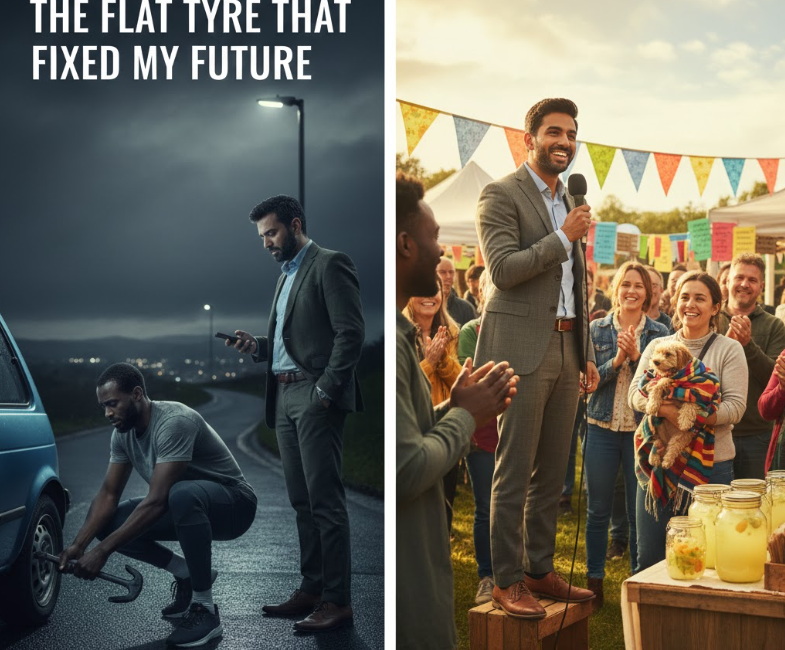
A small crowd had gathered by the stall across from mine. People were clapping. A woman held a puppy wrapped in a blanket. I saw Sameer’s face. He stood on a crate and spoke softly into a microphone. He looked healthy and proud. His eyes searched the crowd; then they found me.
He waved, and my heart jumped. After his talk, he ran to my stall and hugged me like a man who would never loosen his hold. “You fixed my night,” he said. “I told them the story at the interview. They offered me the job on the spot.” His grin made his whole face younger. “We opened a small shelter this week.”
The puppy the woman carried was one of the animals from the shelter — a dog left near the river who had been frightened and ill. Sameer introduced me to volunteers and we talked for hours. He offered me a permanent spot helping at the shelter on weekends. “We need people who care,” he said. “You already proved that.”
I said yes.
Working there changed me. I learned how to bathe shaking dogs, how to read a cat’s tiny shifts in mood, how to hold a hand when a frightened hound needed to trust a human again. More importantly, I learned to listen. People came with hard things: losing a job, losing a home, losing hope. We gave their animals a safe place and, in a small way, gave people a reason to keep trying.
Months later, the shelter organised a night drive to pick up an injured dog on the outskirts of town. We drove under a sky full of stars, pulling over where a family had called. The dog was small and brave, shaking against the wind. I remembered the night Sameer and I pushed the car. I thought about how one small choice — hopping down from my run — had been a hinge on which many things turned.
Sometimes we think big change needs big moments. Often it begins at the edge of an ordinary night when someone’s tyre pops and a stranger steps out of their routine. One evening I answered a scared voice on the hill. I fixed a flat tyre. That gave Sameer a job that saved animals and his life’s meaning. That gave me a friend and a new purpose that warmed even the coldest runs.
The shelter still needs help. We always will. If you ever find a tired stranger by the roadside, or a small animal shivering in a box, so much can flow from the single choice to stop. You might think you are only fixing a flat. But you could be fixing a future. You never know which small kindness becomes a turning point.
I run a little slower now. I stop when I hear a squeal. I keep a small tool kit in my running bag, just in case.

Other Articles
I was late.
I drive for Uber