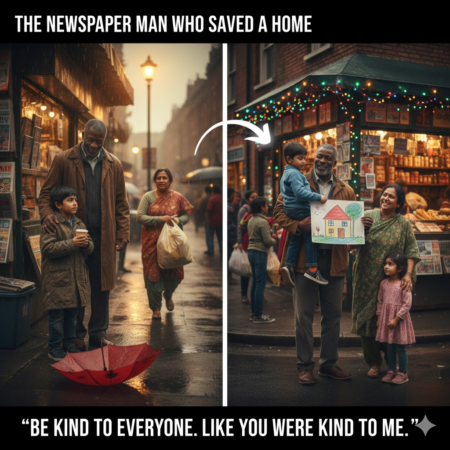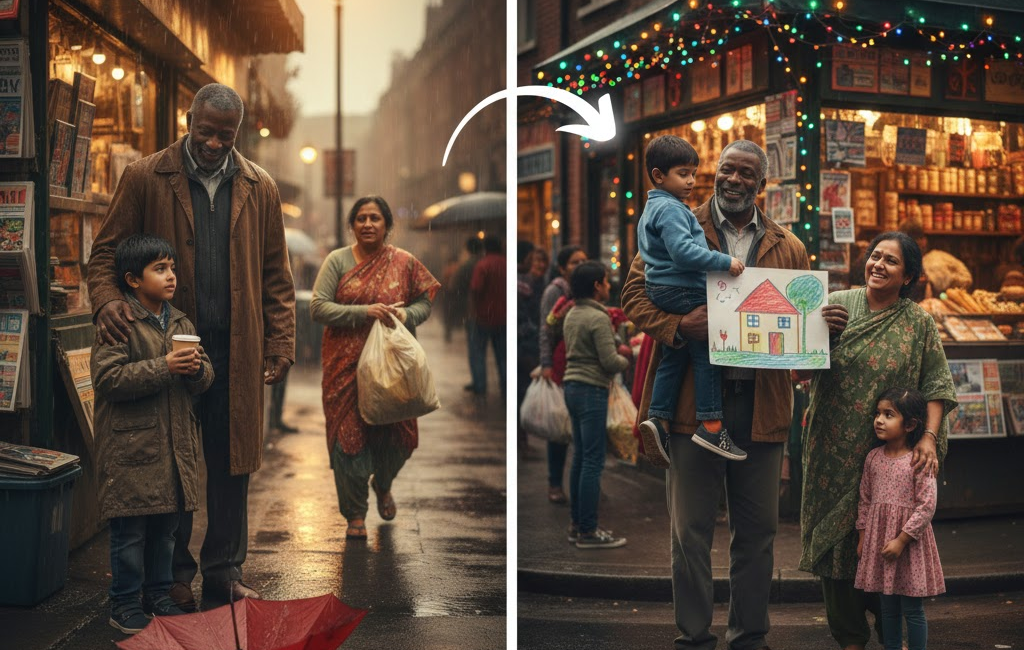

I start work before the sun wakes. The city is quiet then — buses hissing, a baker turning on lights, someone walking a dog. One rainy morning, a boy about seven stood under my stall with a soggy backpack and a red umbrella that had a broken rib. He watched the papers with big, nervous eyes.
“Are you lost?” I asked.
His name was Eli. He said he was trying to find his school but the bus had gone past and his mum had not woken up yet. He clutched a folded note in his hand and kept looking at the street for someone he knew.
I could have shooed him away. I had a day to sell papers and bills to pay. But kids like Eli make a loud kind of quiet — they pull at you until you do something. I put down a stack of comics and took off my old raincoat. “You can wait under the stall,” I said. “I’ll call the school and try to find your mum.”
I dialled the number on the note with my free hand. The school told me they had no record of a boy named Eli, but they agreed to ask around. Meanwhile, I wrapped Eli in the coat and gave him a warm paper cup of cocoa from the café next door. He sipped it slowly and told me in small bursts that his mum worked at the laundromat and she sometimes slept badly. He pointed down the road to a pale building and said, “She said to go to school if she isn’t here.”
The rain fell harder. Cars splashed through puddles and people hurried by. A woman paused at the stall and asked about the boy. I gave her Eli’s note to read. She frowned and said, “I think I know that handwriting.” She went down the street and returned with a tired-faced woman who walked carefully, arms full of laundry. The woman’s eyes filled when she saw Eli.
“Sweetheart,” she said, bending down. “I’m so sorry. I woke late. I didn’t know.” Eli ran and hugged her like he had discovered air again. They spoke quickly in the kind of way people do when they must explain and forgive at once. The woman thanked me and offered to pay for the cocoa. I refused with a short wave.
That should have been the end of the story. Eli left with his mum and I went back to selling the Times and the comics. But the woman — her name was Rosa — came back the next day with a bag of warm pastries. She said she wanted to thank me for watching her son. We talked while the rain kept coming and going like a poor player at the window. Rosa worked long hours and sometimes fell asleep because she had two jobs and little money. She also had a plea.
“My neighbour,” she said quietly, “lost her home when her husband left. She has two little children. They come to the laundromat sometimes to warm up. I want to help them but I cannot do it alone.” Rosa’s hands trembled a little as she spoke. “Maybe you can help? You meet so many people here every morning.”
I sold papers and met many faces, yes. I also had two kids at home and rent to pay. Helping costs time and money. I thought of Eli’s soaked umbrella and the relief in his mother’s eyes. For a strange second the choice felt simple. I said, “Tell me where she lives.”
Rosa gave me an address and a name: Mrs Patel, third floor, the block by the river. That afternoon, after I closed the stall, I walked the wet streets and knocked on the door. A young woman answered with tired eyes and two children clinging to her legs. The apartment was small and cold. She had lost the job that month and the landlord had added pressure. She looked like someone who had been made small by hard things.
I started with what I had — a bag of groceries from the shop across the street and a promise. I offered to watch the children for a few mornings so the woman could search for work, help fill in job forms, and find a calm place to call a friend. She cried softly and said yes.
Word moved slowly but it moved. Rosa told others. A teacher from the school brought books and a volunteer from the library offered free reading sessions for the kids. The bakery provided leftover bread. People who once passed on the street began to notice Mrs Patel’s children with kinder eyes.
Months later, the woman found a part-time job at a café. Not much, but steady. The landlord agreed to a small payment plan when he saw community offers. The children grew less hungry and learned to read with the library volunteer. Rosa and I checked in with Mrs Patel often, bringing soup or a warm blanket when the nights were cold.
One morning, Mrs Patel stopped by my stall with her two children in tow. The little boy handed me a drawing — crayon trees and a bright sun and a big, crooked house. “Thank you,” the boy said, with the honesty of small people. The woman hugged me. “You sold papers and helped me save our home,” she said. “We are not forgotten now.”
The town had not changed in a single headline. The river still smelled of rain. The tram’s horn still made the morning jump. But something small and steady had shifted: a network of people who noticed, who stepped in where life threatened to crack.
I kept selling papers. I kept giving my raincoat when a child waited in the cold. I kept a small stack of pastries at the stall for those who seemed like they had the next day to fight for. Some said I was naïve to spend time helping while money was tight. Some called it a soft heart. I called it remembering Eli’s eyes under my stall and Rosa’s tired gratitude.
Years later, when my children were older and my rent was steadier, I thought back to that rainy morning. The town was still noisy and kind of rough, and I had papers to fold and the shelf to refill. One morning a young woman stopped and handed me a small envelope. Inside was a ticket for the local lottery and a note: “For your faith in people. — Mrs Patel.”
I laughed until I cried. I had never expected a reward. The prize was small but the line of kindness was long. That was the reward. I had learned that when you stop for someone’s small trouble — a child lost in the rain, a mother sleeping because she is tired — you make a place where people can come together. You make neighbours from strangers.
If ever you stand by a corner stall in a quiet morning and see a child with wet hair, don’t walk on. Stop. Call the school. Give them a hot drink. Sit with them a little while. Small things grow into steady things. Small kindness becomes the town’s pulse.

Other Articles

I run a small photo booth at the weekend fair.
I was late.